Decoding the 2026 Mandatory Merger Control Regime: Key Concepts for Competition Law Students
The year 2026 marks the most significant turning point in Australian competition law in over half a century. On January 1, 2026, the long-standing informal merger clearance process was officially replaced by a rigorous, mandatory and suspensory merger control regime. For law students, this isn’t just a minor legislative update; it is a total overhaul of how the Australian Competition and Consumer Commission (ACCC) interacts with the business world.
If you are currently tackling competition law units or preparing for a career in M&A, understanding this new landscape is non-negotiable. The days of “flying under the radar” are over for many corporations. This guide breaks down the essential pillars of the 2026 reforms to help you master your next case study or research essay.
1. Moving from Voluntary to Mandatory: The New “Duty to Notify”
Previously, Australia operated under a voluntary regime where companies could choose whether to notify the ACCC of a merger. If they didn’t, and the merger turned out to be anti-competitive, the ACCC had to take them to court to stop it.
As of 2026, the burden has shifted. If a transaction hits specific financial or “control” thresholds, the parties must notify the ACCC. More importantly, the regime is “suspensory,” meaning companies cannot “close” or finalize the deal until they receive a green light from the regulator. Completing a deal without approval now makes the transaction legally void, creating massive risks for law firms and their clients.
2. The Monetary Thresholds: Who is Caught?
A core part of your exam prep will likely involve calculating whether a deal needs notification. The 2026 rules use a two-tiered system to capture both massive global mergers and smaller, “creeping” acquisitions.
- The Economy-Wide Test: This applies if the combined Australian turnover of the parties is $200 million or more, AND either the target has revenue of $50 million or the transaction value is at least $250 million.
- The Very Large Acquirer Test: This is a “sensitivity” threshold. If an acquirer has Australian revenue of $500 million or more, they must notify the ACCC even if the target is small (as low as $10 million in revenue).
Navigating these numbers while managing a full course load is tough. Many students find that professional australia assignment help is a great way to get a handle on these technical calculations and ensure their legal problem questions are answered with precision.
See also: Email Marketing for Lawyers: How Law Firms Can Win More Clients in the USA
3. The “Creeping Acquisition” Crackdown
One of the biggest drivers for this reform was “creeping acquisitions”—where a large company buys many small competitors over several years. Individually, these small deals don’t hurt competition, but collectively, they can destroy it (think of a major supermarket buying up independent grocers one by one).
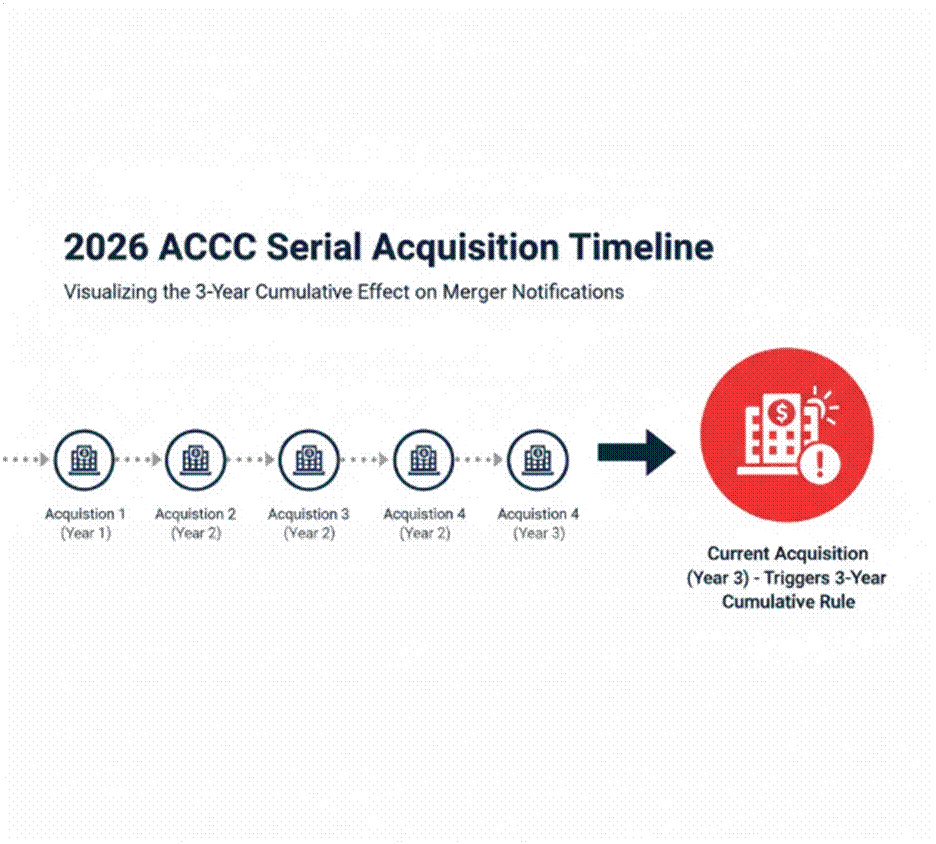
In 2026, the ACCC now looks at the cumulative effect of all acquisitions made by a company in the same or related sectors over the previous three years. If the total revenue of these “serial” acquisitions hits the threshold, the latest deal must be notified. This is a brilliant topic for an essay on market concentration and regulatory intent.
4. Defining “Control” in 2026
For students, the word “merger” usually implies one company buying another entirely. However, the 2026 regime is broader. It covers any acquisition of “control.”
Under the Corporations Act and the new ACCC guidelines, control isn’t just about owning 51% of the shares. It includes the power to determine the financial and operating policies of a business. Even a minority stake (like 20%) can be considered “control” if the shareholder has special voting rights or the ability to appoint board members. If you’re struggling to apply the Section 50AA control tests to a hypothetical scenario, seeking law assignment help can provide you with clear, structured examples of how the courts interpret these powers.
5. The Assessment Process: Phase 1 vs. Phase 2
The ACCC has introduced a “two-phase” administrative process to keep the economy moving while still catching bad deals.
- Phase 1 (The Fast Track): The ACCC has 30 business days to decide if the deal is “clear.” About 80% of deals are expected to pass here or receive a “notification waiver.”
- Phase 2 (The Deep Dive): If the ACCC has “competition concerns,” they move to Phase 2. This is a much longer, more expensive process involving “Notices of Competition Concerns” and public submissions.
For students, the key takeaway is the timeline. Lawyers now have to build “ACCC approval” time into their contracts, often adding 3 to 6 months to a deal’s timeline.
6. The “Substantial Lessening of Competition” (SLC) Test
Even though the process has changed, the legal test remains focused on Section 50 of the Competition and Consumer Act. The ACCC must decide if a deal will “substantially lessen competition.”
However, the 2026 reforms clarified that “lessening competition” includes conduct that “creates, strengthens, or entrenches a position of substantial market power.” This is a lower bar for the ACCC to clear, making it easier for them to block deals in digital markets or highly concentrated industries like banking and groceries.
7. Public Benefits and the Tribunal
What if a merger does lessen competition but is actually good for the country? (For example, a merger that saves a failing essential service or helps Australia reach “Net Zero” targets).
Companies can still argue that the “public benefit” outweighs the competition harm. If the ACCC says no, the companies can appeal to the Australian Competition Tribunal for a “merits review.” This is a critical area for students to study, as it combines economic theory with administrative law.
8. Practical Tips for Law Students in 2026
Competition law is no longer just about reading old cases; it’s about understanding real-time regulatory shifts. Here is how you can stay ahead:
- Monitor the ACCC Public Register: Every notified merger is now listed publicly. Reading these entries is the best way to see the law in action.
- Focus on the Economics: You don’t need to be a mathematician, but you must understand concepts like “barriers to entry,” “vertical integration,” and “market substitutes.”
- Learn the Forms: The new “prescribed forms” for notification require specific data. Familiarizing yourself with these will make you a much more valuable graduate hire.
9. Why These Changes Matter for Your Career
If you are entering the workforce in 2026 or 2027, you will be among the first generation of lawyers to work exclusively under this mandatory regime. Senior partners will be looking for graduates who actually understand the nuances of the new thresholds and the “three-year cumulative” rule.
The move toward an administrative model (where the ACCC is the decision-maker) also means that “Advocacy” is changing. You aren’t just arguing in front of a judge; you are negotiating with a regulator. This requires a different set of writing and persuasion skills—something that is often emphasized in modern university law curriculums.
Conclusion: A New Era of Legal Scrutiny
The 2026 Mandatory Merger Control Regime is designed to make the Australian economy more transparent and competitive. By removing the “hide and seek” nature of the old voluntary system, the government has empowered the ACCC to take a proactive role in shaping market dynamics.